Urganis: Her Domain
As the ruler of Urganis, Obsidienne shaped the continent according to her ideals. After the First Demon War, she set about strengthening the defenses of her lands, creating solid structures and divine protections to preserve her people from external threats. She instilled in the hearts of Urganis' inhabitants the value of collective effort, encouraging a society where everyone contributes to the common good.
Divine Lore
Origins and Nature
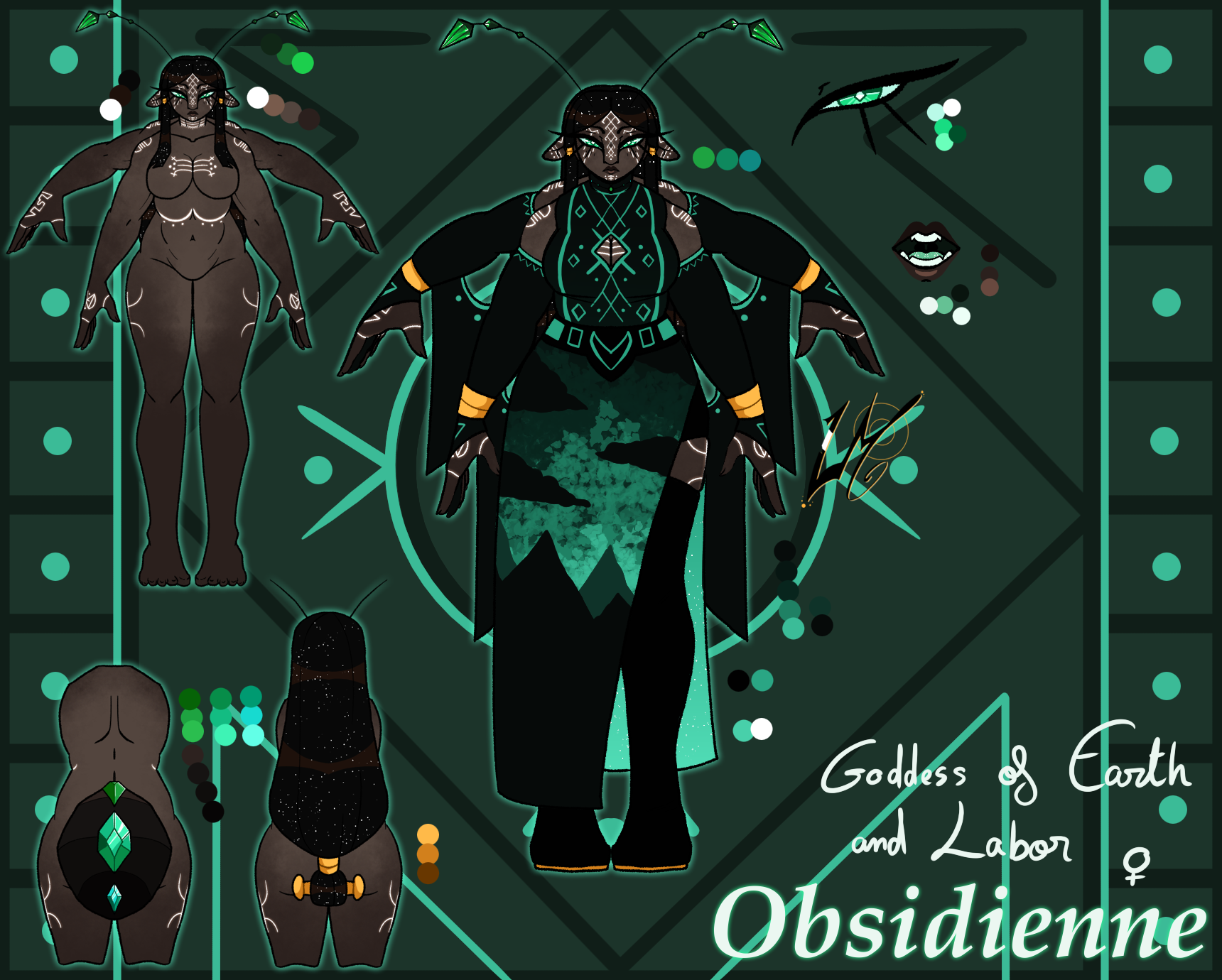
Obsidienne is the major goddess reigning over the continent of Urganis, embodiment of effort, duty and perseverance. Creator of the minor gods Jasmine, Agllid and Oudmaoun, she is also the mother of Tinnit and Amsgar. Obsidienne is a powerful figure, whose unwavering will has shaped the destiny of her people and the very structure of the world she governs.
Born from the primordial forces of the universe, Obsidienne emerged as a goddess dedicated to construction, protection and constant improvement. Her name, evoking volcanic stone, symbolizes her hardness, resilience and ability to shape the world. She sees in effort the true measure of an individual's worth, believing that it is through hard work and perseverance that one achieves true greatness.
Creation of the Minor Gods
To assist her in her divine mission, Obsidienne gave birth to several minor gods:
Jasmine
The goddess of protection and motherhood, who watches over the most vulnerable and whose giant worms protect the strategic points of Urganis.
Agllid
The first of the minor gods is a rock giant who rises above the heavens, possessing colossal strength allowing him to part seas and calm storms. He was created with the purpose of dividing the continents for the Major Gods, so that each could possess their own lands and people. This titanic task absorbed him for decades, without respite or rest.
After accomplishing such an endeavor, marked by its importance, difficulty and length, Obsidienne offered him a peaceful existence, free from worries, honored as the minor god who had achieved one of the most important tasks there are. Despite this tempting offer, Agllid declined. He did not wish for a life devoid of clear purpose. He then asked Obsidienne for something else: to be erased, to no longer exist until Obsidienne had a new task for him. Which she accepted.
After millennia had passed, a new mission worthy of Agllid was revealed. As the people, villages and cities of Urganis flourished ceaselessly, Obsidienne felt the pressing need to organize the divine hierarchy more efficiently. Indeed, with the multiplication of churches and, by extension, the Elemental Fathers, it became crucial to have someone to gather information from the elementals, discern the most crucial data, transmit it and supervise the organization and affairs of the sanctuaries. It was then that Obsidienne brought Agllid back from his non-existence in a new form, destined to fulfill this task with devotion and insight.
Warm, magmatic, grandiose, divine. Thus, the people would describe this new deity they had never seen before, far from suspecting that it is in reality the same as the legendary rock giant who moved continents. A sort of mystery surrounds this transformation, and the recognition of the true identity of this deity brings a wonder mixed with a deep understanding of the legendary heritage that unfolds before the amazed eyes of the mortals who learn this truth.
“For a long time, Obsidienne had her own church and cult, but she delegated everything — or almost — to Agllid upon his creation.”
— Chronicles of UrganisOudmaoun
The mysterious god of a thousand faces, master of secrets and control, tasked with tracking down the most recalcitrant heretics.
Her Children: Tinnit and Amsgar
Tinnit
Tinnit is an emblematic figure of reconciliation, adopted by Obsidienne after the Demon War. Tinnit symbolizes forgiveness and unity, representing the hope of peaceful coexistence between the different races.
Amsgar
Amsgar is the son she had with the mortal Elise. Eager to forge his own path, Amsgar renounced his immortality to become a mortal and joined Obsidienne's Inquisition, climbing the ranks through his own merit. His quest to prove his worth independently of his divine lineage reflects the complexity of Obsidienne's family relationships.
The Precepts of Obsidienne
Obsidienne is guided by strong principles, which she teaches her faithful as pillars of morality and society:
1. Wealth without work
She condemns the acquisition of wealth without effort, believing that only honest work and effort deserve reward.
2. Pleasure without conscience
She advocates an enjoyment of life that does not neglect moral responsibilities, rejecting selfish pleasure that harms others.
3. Knowledge without character
For Obsidienne, knowledge only has value when it is put in the service of others. To know and do nothing with it, or to use it for selfish ends, amounts to betraying the gift of knowledge.
4. Worship without sacrifice
She teaches that true devotion requires personal sacrifices, that faith without actions to support it is hollow.
These precepts are taught in all the churches of Urganis, serving as the foundation of the continent's culture and law. They encourage inhabitants to lead a life of work, morality and sincere devotion.